Overview
1. Impact to the industry
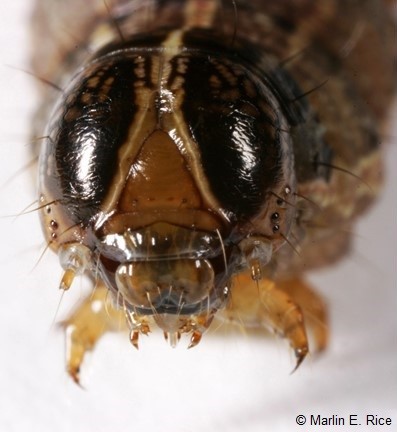
The larval stage of the fall armyworm (FAW) is a pest that can damage and destroy a wide variety of crops causing large economic loss. Outbreaks usually occur during the early part of the summer.
Destruction of crops can happen almost overnight, because the first stages of a larva’s life require very little food, and the later stages require about 50 times more. Because of this rapid change in food consumption, the presence of larva will not be noticed until they have destroyed almost everything in as little as a night.
• The fall armyworm attacks >350 plant species from 76 plant families.
• Examples of targeted crops include: sweet corn, sorghum, grasses, cereals, fruits and many more. The list of possible food sources for the larvae is extensive. Because the larva eat so much of the plant, they are extremely detrimental to crop survival and yield.
• It is most commonly recorded from wild and cultivated grasses; from maize, rice, sorghum and sugarcane.
• It occurs in two races: a ‘rice strain’ (R strain) and a ‘corn strain’ (C strain).
• While both strains have been detected in Africa and Asia, work is currently underway to determine which strain is attacking in New Zealand.
2. Why is fall armyworm so devastating?
Key pest status – Maize yield losses of 70% were reported in Central America when the pest was not controlled. Crop destruction (100%) in Brazil was reported when late stage larvae acted as a seedling cutworm. Damage across the globe estimated in billions of dollars.
Highly polyphagous – Reported feeding on over 350 host plant species from 76 plant families. FAW has already been reported feeding on maize and sweetcorn in northern New Zealand.
High reproductive rate – Females capable of producing 2000 eggs in their lifetime.
Highly migratory pest – Adults able to travel 100 km per night and 500 km prior to oviposition when assisted by strong winds. Larvae occasionally relocate to nearby suitable crops. Persist year-round in tropical environments – Eight to ten generations per year in some regions and lack of diapause allow this pest to infest crops at any time of year.
Cryptic feeding and behaviour – Adults hide during the daytime; ground migrating larvae may hide under crop cover; larvae feed deep in the whorl. These behaviours allow this pest to go undetected, avoid predation and make it difficult to reach with foliar sprays.
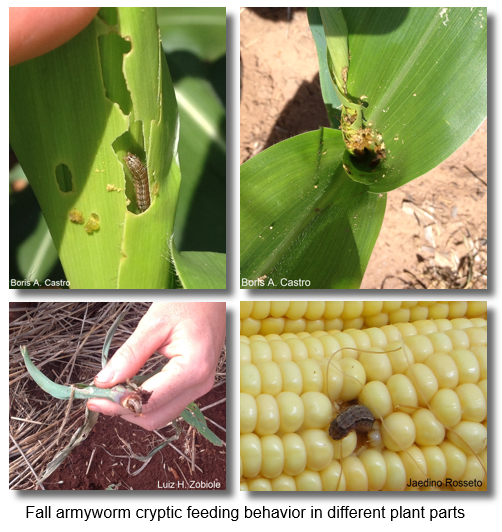
Multiple feeding behaviours – Defoliator, ear and flower feeder, seedling cutter. The fall armyworm feeds on almost any above-ground plant part.
Difficult to control – Natural levels of tolerance to some insecticidal proteins and demonstrated ability to develop resistance to insecticides and transgenic traits.
Transboundary pest – Reported in more than 90 countries, capable of dispersing further via commercial trade or strong migratory flight behaviour.
3. Fall armyworm spread in New Zealand
Adults are capable of flying long distances. Their migration rate is remarkably fast, estimated at almost 500 kilometres per generation. They can also spread through people movement, with it believed that their arrival in Africa was via a passenger flight.
• Fall armyworm is adapted to the warmer parts of the World; the optimum temperature for larval development is reported to be 28°C.
• In the tropics, breeding can be continuous with four to six generations per year, but in cooler regions only one or two generations develop; at lower temperatures, activity and development cease, and when freezing occurs all stages are usually killed.
• Fall armyworm can survive north of Latitude 35 south and thrive in warm climates.
- Absolute minimum temperature (ºC) 8.2
- Mean annual temperature (ºC) 17-35
- Mean maximum temperature of hottest month (ºC) 30-35
- Mean minimum temperature of coldest month (ºC) 7-17
It is anticipated that the geographical spread will be across the northern north island of New Zealand while migration further south MAY occur, especially over the summer months.