Share:

Corporate Global
Corporate Global
Africa
Asia Pacific
Australasia
Europe
Latin America and Caribbean
North America
Corporate Global

Maximizing Food Chain Access for Fruits and Vegetables
The global market for produce has changed expectations for consumers and expanded possibilities for farmers. Consumers expect a wide variety of fruits and vegetables to be readily available, high quality and affordable all year round. This opens opportunities for farmers to sell to more markets and increase their profitability.
To supply this global market, farmers must navigate a complex set of standards, including Maximum Residue Levels (MRLs), Import Tolerances (ITs) and food-chain-specific requirements. Corteva Agriscience is committed to delivering farmers transparent, easy-to-understand information about residue calculations for our crop protection product portfolio. When farmers have the best information to make crop protection decisions, more beautiful, tasty, nutritious fruits and vegetables can make it into the market — and onto our plates.
- Understanding MRLs
- More than MRLs
- Common Questions
Understanding MRLs and ITs
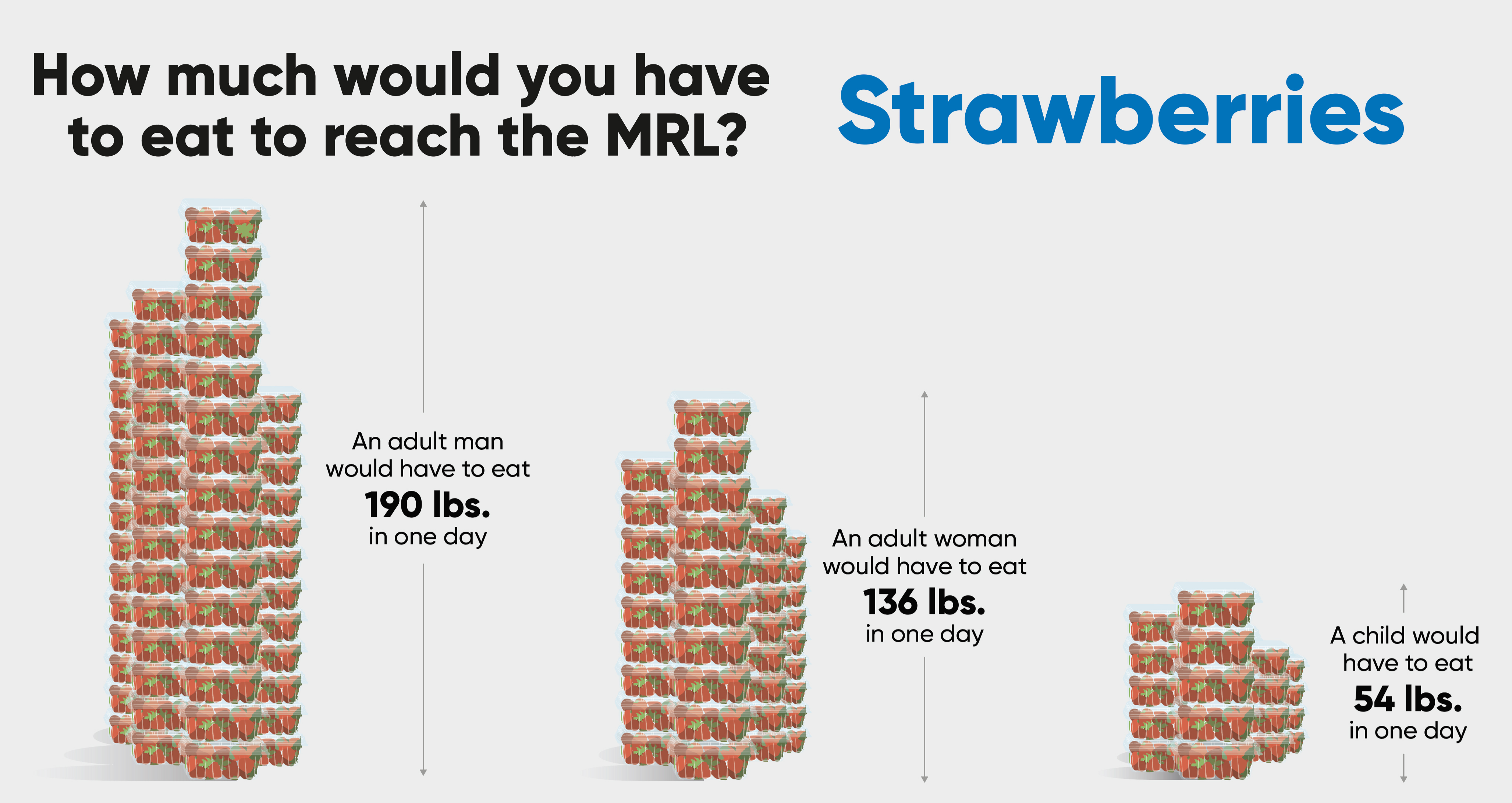
MRL stands for Maximum Residue Level. An MRL is the highest concentration of crop protection product residue legally allowed for domestic and internationally traded food products. The purpose of an MRL isn’t to establish the safety or toxicity of a particular crop protection product. Instead, MRLs are a way to monitor whether a crop protection product was used properly, according to Good Agricultural Practices (GAP). For example, if a product was used at recommended rates, the recommended number of times and at the correct pre-harvest interval, any detectable residue will not exceed the MRL. Regulatory authorities selectively test imported and domestic crops to ensure MRLs are not exceeded.
IT stands for Import Tolerance. While MRLs apply to domestic and exported crops, IT is a type of MRL set by the importing country or region. An IT is the amount of crop protection product residue permitted in or on a commodity imported after it was produced in another country. ITs may be used for crop protection products that are not currently approved in the importing country, or if the importing country has a different MRL standard than what the crop is likely to have.
MRLs and ITs are trade standards established and monitored by regulatory authorities. Food chain customers may use these standards as a guide for accepting produce, but they are also setting secondary restrictions that are stricter than their local MRL and IT levels. Some retailers, for example, may set a secondary limit at 30% of the regulated MRL for a particular crop protection product.
Supporting Crop Marketability Beyond MRLs
As the makers of crop inputs, Corteva Agriscience is part of the food chain, helping farmers grow fruits and vegetables that are beautiful, tasty, nutritious and marketable. When Corteva develops crop protection products, MRLs and ITs are not afterthoughts — they are integral to how our products are designed, and help determine which ones earn a place in our pipeline.
Our regulatory teams analyze trends in trade and marketing so that farmers choosing Corteva crop protection products — and the food chain partners they market to — can feel confident in meeting MRL and IT requirements. The Corteva Food Chain CoNNEXT service supports farmers and food chain partners in maintaining the freedom to trade and market crops, while meeting consumer and regulatory demands.
CoNNEXT uses predictive modeling and residue trials to obtain data for meeting residue requirements. Findings are shared through communication materials advising farmers on applying crop protection products in order to respect MRL/IT requirements in importing countries. CoNNEXT also provides guidance for farmers to achieve residues below 0.01 mg/kg. This helps farmers market their products in countries that don’t have a particular MRL established and it can facilitate their access to food chain customers with below-regulation restrictions, such as specialty retailers and food companies.
Supporting Crop Protection Products in Minor Use Crops
Crop protection products are not always registered or have MRLs established for all of the crops in which they can be used. The Minor Use Foundation works to secure registration and MRLs for products that help protect these crops and open up market opportunities for farmers. These videos show how the Foundation and its partners were able to register crop protection products that are vital in mango and avocado farming.

Impact: Tools for Avocado Producers in Colombia
Learn how the Minor Use Foundation project in Colombia helped avocado producers increase yields by 20%, open valuable export markets and increase returns for farmers.
Impact: Tools for Avocado Producers in Colombia
Learn how the Minor Use Foundation project in Colombia helped avocado producers increase yields by 20%, open valuable export markets and increase returns for farmers.

Impact: Kenya Mango Project
20 to 40% of global agricultural production is lost every year due to pests and diseases. Learn how the Minor Use Foundation project in Kenya is helping mango growers increase yields, improve quality and raise returns on farmer investments.
Impact: Kenya Mango Project
20 to 40% of global agricultural production is lost every year due to pests and diseases. Learn how the Minor Use Foundation project in Kenya is helping mango growers increase yields, improve quality and raise returns on farmer investments.
Common MRL Questions
Global MRL Resources
Use the map to visit MRL guidelines for specific regions and countries. For global information, visit Codex Alimentarius, HOMOLOGA (subscription required), and Bryantchristies (subscription required).
Always consult with local experts for the most up-to-date MRL information.