Share:

Corporate Global
Corporate Global
Africa
Asia Pacific
Australasia
Europe
Latin America and Caribbean
North America
Corporate Global
Climate Smart Agriculture: Championing Newer, More Sustainable Practices

The effects of climate change on agriculture will be profound. Here’s how two very different farmers are learning to cope.
Farmers feed the world. We need them to now and will even more in the future. Our ever-growing world population is projected to hit 10 billion by 2050, and agricultural production must somehow keep pace.
But many farmers across the world are already struggling, thanks to the unprecedented frequency of dramatic weather events, rising temperatures, droughts, flooding, and other outcomes of climate change. Ironically, we are biting the hand that feeds us: agriculture is also responsible for somewhere between 25 and 30 percent of global greenhouse-gas emissions (the exact number is very difficult to pin down). How can we produce even more food while minimizing farming’s environmental impact?
Many farmers are taking matters into their own hands, practicing more-sustainable, climate-smart ways of growing their crops and livestock. Of course, farmers alone—even those with the most-powerful ties to their land and the most-sustainable, well-managed farming practices—cannot reverse the effects of climate change. But the methods they use can enable them to survive and thrive—to grow better, healthier food while they mitigate some of the damage from climate change. In doing so, these farmers are helping create the future of agriculture and helping to mend the planet for later generations.
Measuring the impact
There is no one way in which climate change affects all farming regions and the myriad crops grown across the globe—just as there is no single action that can solve this incredibly complex problem. In some areas of the world, rising sea levels, traumatic weather events, and warmer temperatures are undermining farmers’ ability to feed their families, let alone to make a viable living. In other places, however, the effects are more subtle. There are even regions, such as parts of northern Europe, where increased temperatures are actually improving crop yields, at least in the short term. There is no question, however, that the net effect of climate change worldwide is to diminish our ability to grow food.
The impact of climate change on our food supply is already quantifiable. A recent study from the University of Minnesota’s Institute on the Environment analyzed weather and crop data from 20,000 growing regions around the world between 1974 and 2008. The conclusion: changes in temperature and precipitation have already reduced consumable food overall by about 1 percent for the top ten crops (maize, rice, wheat, soybean, palm oil, sugarcane, barley, rapeseed/canola, cassava, and sorghum). While that may not sound like much, it amounts to enough calories—35 trillion annually—to feed more than 50 million people. Sadly, these decreases in production are most profound in the regions that are most food insecure—the very areas least able to tolerate the losses.
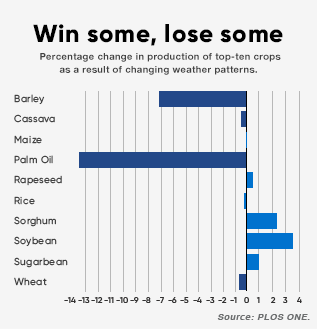
Greenhouse-gas emissions are contributing to changes that ultimately cause decreases in crop yields. As these yields diminish and demand increases, farmers in some regions are carving more farmland out of forests and other open lands—which in turn further contributes to global warming. In the last 30 years, we have lost 10 percent of the world's forests, according to the 2022 State of the World’s Forest report.
Looking forward
A closer look at individual crops in specific regions tells a story that may help some areas. Climate change is reducing wheat yields by 0.9 percent each year but is increasing yields of drought-tolerant sorghum by 0.7–0.9 percent. Growing alternative crops like sorghum that can thrive in changed conditions may be one way of helping regions that are hit hardest by changed weather patterns.
Regardless of their region, the crops they grow, and how profoundly their changing climate currently does or does not affect their yields, farmers across the world are beginning to share an unwillingness to sit back and passively let climate change happen. In some areas, farmers have simply had to change the way they farm in order to survive. Even in regions where they are not currently experiencing climate change-related losses, many farmers are already doing what they can to protect the earth around them.
Farmers across the world are beginning to share an unwillingness to sit back and passively let climate change happen.


Further reading
“Place Matters: An Investigation of Farmers’ Attachment to Their Land.” Courtney E. Quinn and Angela C. Halfacre. Human Ecology Review, Volume 20, Number 2, 2014. http://press-files.anu.edu.au/downloads/press/p291621/pdf/ch062.pdf
“Global Warming May Benefit Some Farmers.” Lise Brix. (Science Nordic, 2014). https://sciencenordic.com/agriculture-denmark-drought/global-warming-may-benefit-some-farmers/1412163
“Climate Change Has Likely Already Affected Global Food Production.” D.K. Ray et al. (PLoS ONE 14[5], 2019). https://journals.plos.org/plosone/article/file?id=10.1371/journal.pone.0217148&type=printable
“Deforestation Explained.” Christina Nunez. (National Geographic, 2019). https://www.nationalgeographic.com/environment/global-warming/deforestation/#close
“Climate Change is Affecting Crop Yields and Reducing Global Food Supplies.” Deepak Ray. (Cornell Alliance for Science, 2019). https://allianceforscience.cornell.edu/blog/2019/07/climate-change-affecting-crop-yields-reducing-global-food-supplies/
“Climate-Smart Agriculture.” (World Bank, 2019).
https://www.worldbank.org/en/topic/climate-smart-agriculture
“What Is Soil Carbon Sequestration?” (Food and Agriculture Organization, 2019). http://www.fao.org/soils-portal/soil-management/soil-carbon-sequestration/en/
“Long-Term Study Shows Crop Rotation Decreases Greenhouse Gas Emissions.” Press release (American Association for the Advancement of Science, 2019). https://www.eurekalert.org/pub_releases/2018-05/uoic-lss052318.php
“Climate Risk Country Profile—Vietnam.” Alex Chapman et al. (World Bank, 2018). https://climateknowledgeportal.worldbank.org/sites/default/files/2019-01/15077-VietnamCountryProfile.pdf